
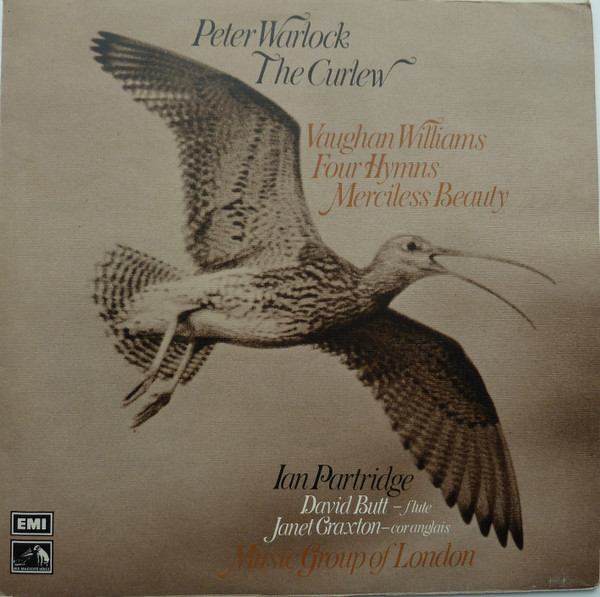
Description
Media Condition: Very Good Plus (VG+)
Sleeve Condition: Very Good Plus (VG+)
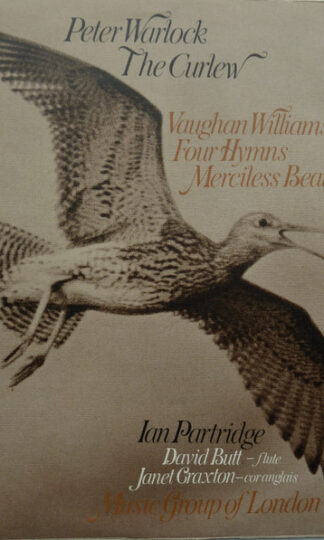
WE SHIP WORLDWIDE. Record has one or two very fine paper surface marks. Textured sleeve has minor shelfwear and a small sticker at the top of the back cover. 1974 UK pressing on His Master’s Voice.
Notes:
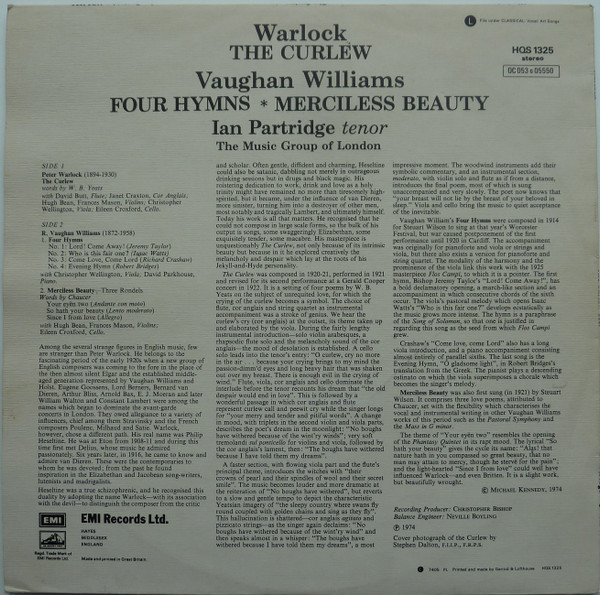
Issued with 4-page insert containing texts.
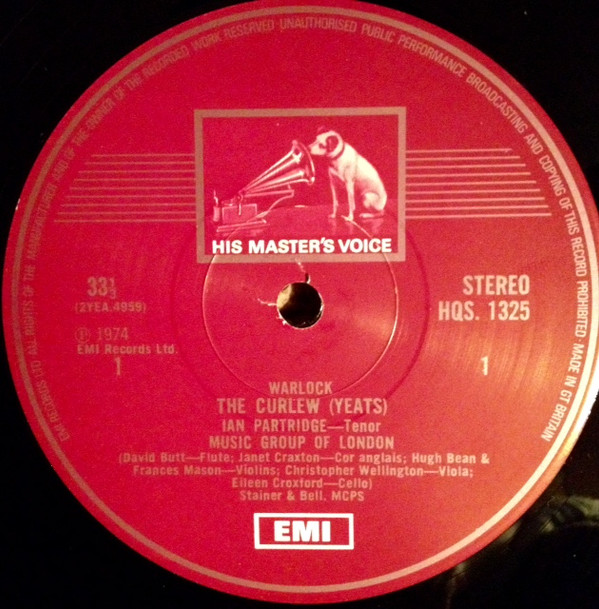
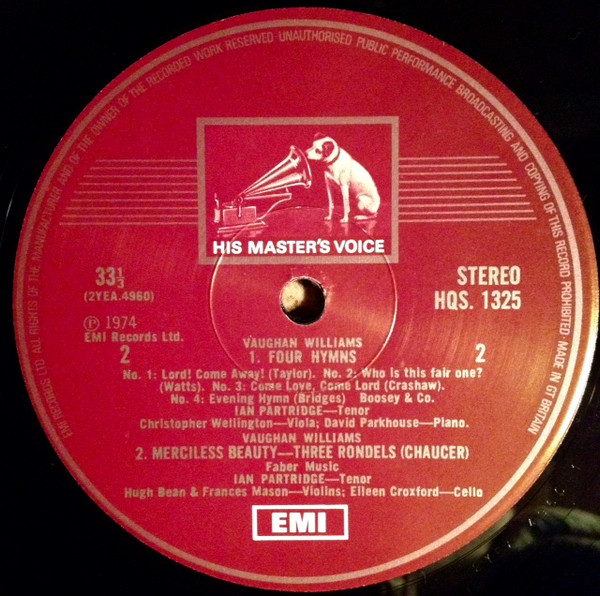
Copies exist with “Odeon” gold foil stickers applied onto all His Master’s Voice branding on release (sleeve front/back and labels). This was standard UK stock prepared for export to markets (The Americas and Japan) where EMI had no right to the use of the Dog-and-phonograph trade mark.
“7405 PL” in the Printer’s date stamp / code suggests a Release Date around May 1974 and indicates the Printing Plate used was made by Planet Litho.
Transcription of liner notes:
Among the several strange figures in English music, few
are stranger than Peter Warlock. He belongs to the
fascinating period of the early 1920s when a new group of
English composers was coming to the fore in the place of
the then almost silent Elgar and the established middle-
aged generation represented by Vaughan Williams and
Holst. Eugene Goossens, Lord Berners, Bernard van
Dieren, Arthur Bliss, Arnold Bax, E. J. Moeran and later
William Walton and Constant Lambert were among the
names which began to dominate the avant-garde
concerts in London. They owed allegiance to a variety of
influences, chief among them Stravinsky and the French
composers Poulenc, Milhaud and Satie. Warlock, A
however, chose a different path. His real name was Philip
Heseltine. He was at Eton from 1908-11 and during this
time first met Delius, whose music he admired
passionately. Six years later, in 1916, he came to know and
admire van Dieren. These were the contemporaries to
whom he was devoted; from the past he found
inspiration in the Elizabethan and Jacobean song-writers,
lutenists and madrigalists.
Heseltine was a true schizophrenic, and he recognised this
duality by adopting the name Warlock – with its association
with the devil to distinguish the composer from the critic and scholar.
Often gentle, diflident and charming, Heseltine
could also be satanic, dabbling not merely in outrageous
drinking sessions but in drugs and black magic. His
roistering dedication to work, drink and love as a holy
trinity might have remained no more than tiresomely high-
spirited, but it became, under the influence of van Dieren,
more sinister, turning him into a destroyer of other men,
most notably and tragically Lambert, and ultimately himself.
Today his work is all that matters. He recognised that he
could not compose in large scale forms, so the bulk of his
output is songs, some swaggeringly Elizabethan, some
exquisitely tender, some macabre. His masterpiece is
unquestionably The Curlew, not only because of its intrinsic
beauty but because in it he explored creatively the
melancholy and despair which lay at the roots of his
Jekyll-and-Hyde personality.
The Curlew was composed in 1920-21, performed in 1921
and revised for its second performance at a Gerald Cooper
concert in 1922. It is a setting of four poems by W. B.
Yeats on the subject of unrequited love, for which the
crying of the curlew becomes a symbol. The choice of
flute, cor anglais and string quartet as instrumental
accompaniment was a stroke of genius. We hear the
curlew’s cry (cor anglais) at the outset, its theme taken up
and elaborated by the viola. During the fairly lengthy
instrumental introduction-solo violin arabesques, a
rhapsodic flute solo and the melancholy sound of the cor
anglais-the mood of desolation is established. A cello
solo leads into the tenor’s entry: “O curlew, cry no more
in the air … because your crying brings to my mind the
passion-dimm’d eyes and long heavy hair that was shaken
out over my breast. There is enough evil in the crying of
wind.” Flute, viola, cor anglais and cello dominate the
interlude before the tenor recounts his dream that “the old
despair would end in love”. This is followed by a
wonderful passage in which cor anglais and flute
represent curlew call and peewit cry while the singer longs
for “your merry and tender and pitiful words”. A change
in mood, with triplets in the second violin and viola parts,
describes the poet’s dream in the moonlight: “No boughs
have withered because of the wint’ry winds”; very soft
tremolandi sul ponticello for violins and viola, followed by
the cor anglais’s lament, then: “The boughs have withered
because I have told them my dreams”.
A faster section, with flowing viola part and the flute’s
principal theme, introduces the witches with “their
crowns of pearl and their spindles of wool and their secret
smile”. The music becomes louder and more dramatic at
the reiteration of “No boughs have withered”, but reverts
to a slow and gentle tempo to depict the characteristic
Yeatsian imagery of “the sleepy country where swans fly
round coupled with golden chains and sing as they fly”.
This hallucination is shattered–cor anglais agitato and
pizzicato strings-as the singer again declaims:_“No
boughs have withered because of the wint’ry w1nd” and
then speaks almost in a whisper: “The boughs have
withered because I have told them my dreams”, a most
impressive moment. The woodwind instruments add their
symbolic commentary, and an instrumental section,
moderato, with violin solo and flute as if from a distance,
introduces the final poem, most of which is sung
unaccompanied and very slowly. The poet now knows that
“your breast will not lie by the breast of your beloved in
sleep.” Viola and cello bring the music to quiet acceptance
of the inevitable.
Vaughan William’s Four Hymns were composed in 1914
for Steuart Wilson to sing at that year’s Worcester
Festival, but war caused postponement of the first
performance until 1920 in Cardiff. The accompaniment
was originally for pianoforte and viola or Strlngs and
viola, but there also exists a version for pianoforte and
string quartet. The modality of the harmony and the
prominence of the viola link this work with the 1925
masterpiece Flos Campi, to which it is a pointer. The first
hymn, Bishop Jeremy Taylor’s “Lord! Come Away!”, has
a bold declamatory opening, a march-like section and an
accompaniment in which consecutive chords of the sixth
occur. The viola’s pastoral melody which opens Isaac
Watts’s “Who is this fair one ?” develops ecstatically as
the music grows more intense. The hymn is a paraphrase
of the Song of Solomon, so that one is justiiied in
regarding this song as the seed from which Flos Campi
grew.
Crashaw’s “Come love, come Lord” also has a long
viola introduction, and a piano accompaniment consisting
almost entirely of parallel sixths. The last song is the
Evening Hymn, “O gladsome light”, in Robert Bridges’s
translation from the Greek. The pianist plays a descending
ostinato on which the viola superimposes a chorale which
becomes the singer’s melody.
Merciless Beauty was also first sung (in 1921) by Steuart
Wilson. It comprises three love poems, attributed to
Chaucer, set with the flexibility which characterises the
vocal and instrumental writing in other Vaughan Williams
works of this period such as the Pastoral Symphony and
the Mass in G minor.
The theme of “Your eyén two” resembles the opening
of the Phantasy Quintet in its rapt mood. The lyrical “So
hath your beauty” gives the cycle its name: “Alasl that
nature hath in you compassed so great beauty, that no
man may attain to mercy, though he stervé for the pain”;
and the light-hearted “Since I from love” could well have
influenced Warlock-and even Britten. It is a slight work
but beautifully wrought.
© MICHAEL KENNEDY, 1974
A1. The Curlew
. Four Hymns
. Merciless Beauty- Three Rondels
Matrix / Runout 2YEA.4959
Matrix / Runout 2YEA.4960
Matrix / Runout 2YEA 4959-1
Matrix / Runout 2YEA 4960-1
Rights Society MCPS
Other ?
Other 7405 PL
Phonographic Copyright (p) EMI Records Ltd.
Printed By Garrod & Lofthouse Ltd.
Made By Garrod & Lofthouse Ltd.
Made By Planet Litho
Published By Boosey & Co.
Published By Stainer & Bell
Published By Faber Music