
Description
Media Condition: Very Good Plus (VG+)
Sleeve Condition: Very Good Plus (VG+)
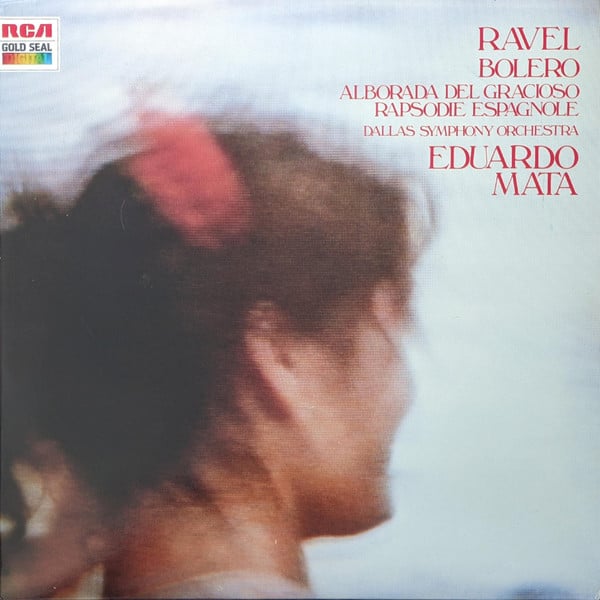
WE SHIP WORLDWIDE. Record has one or two very fine paper surface marks. Sleeve has very minor shelfwear. Europe 1986 pressing on RCA Gold Seal.
Notes:
On Back sleeve:
All timings are approximate
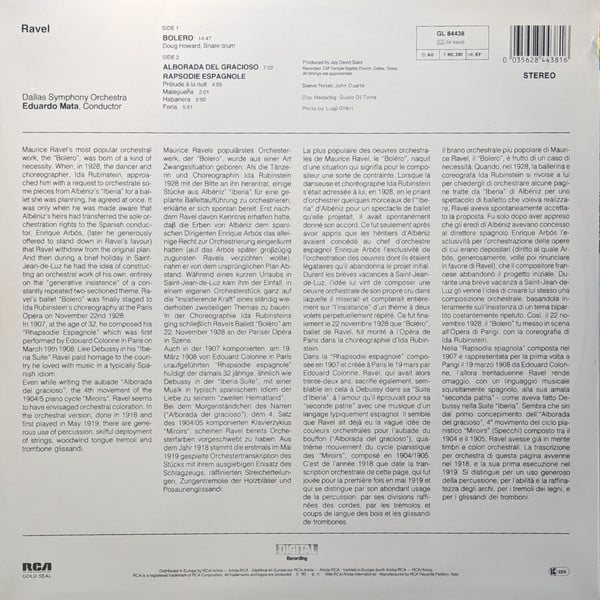
Maurice ravel’s most popular orchestral work, the “Bolero”, was born of a kind of necessity. When, in 1928, the dancer and choreographer, Ida Rubinstein, approached him with a request to orchestrate some pieces from Albéniz’s “Iberia” for a ballet she was planning, he agreed at once. It was only when he was made aware that Albéniz’s heirs had transferred the sole orchestration rights to the spanish conductor, Enrique Arbós, (later he generously offered to stand down in Ravel’s favour) that Ravel withdrew from the original plan. And then during a brief holiday in Saint-Jean-de-Luz he had the idea of constructing an orchestral work of his own, entirely on the “generative insistence” of a constantly repeated two-sectioned theme. Ravel’s ballet “Bolero” was finally staged to Ida Rubinstein’s chreography at the Paris Opera on November 22nd 1928.
In 1907, at the age of 32, he composed hit “Rhapsodie Espagnole” which was first performed by Edouard Colonne in Paris on March 19th 1908. Like Debussy in his “Iberia Suite” Ravel paid homage to the country he loved with music in a typically Spanish idiom.
Even while writing the aubade “Alborada del gracioso”, the 4th movemnet of the 1904/5 piano cycle “Mirois”, Ravel seems to have envisaged orchestral coloration. In the orchestral Version, done in 1918 and first played in May 1919, there are generous use of percussion, skilful deployment of strings, woodwind tongue tremoli and trombone glissandi.
Maurice Ravels populärstes Orchesterwerk, der “Bolero”, wurde aus einer Art Zwangssituation geboren. Ales die Tänzering und Choreographin Ida Rubinstein 1928 mit der Bitte an ihn herantrat, einige Stücke aus Albéniz’ “Iberia” für eine geplante Balletaufführung zu orchestrieren, erklärte er sich spontan bereit. Erst nachdem Ravel davon Kenntnis erhalten hatte, daß die Erben von Albéniz dem spanischen Dirigenten Enrique Arbós das alleinige Recht zur Orchestrierung eingeräumt hatten (auf das Arbós später großzügig zugunsten Ravels verzichten wollte), nahm er von dem ursprünglichen Plan Abstand. Während eines kurzen Urlaubs in Saint-Jean-de-Luz kam ihm der Einfall, in einem eigenen Orchesterstück ganz auf die “insistierende Kraft” eines ständig wiederholten zweiteiligen Themas zu bauen. In der Choreogrphie Ida Rubinsteins ging schließlich Ravels Ballett “Bolero” am 22. November 1928 an der Pariser Opéra in Szene.
Auch in der 1907 komponierten, am 19. März 1908 von Edouard Colonne in Paris uraufgeführten “Rhapsodie espagnole” huldigt der damals 32 jährige, ähnlich wie Debussy in der “Iberia-Suite”, mit einer Musik in typisch spanischem Idiom der Liebe zu seinem “zweiten Heimatland”.
Bei dem Morgenständchen des Narren (“Alborada del gracioso”), dem 4. Satz des 1904/05 komponierten Klavierzyklus “Miroirs”, scheinen Ravel bereits Orchesterfarben vorgeschwebt zu haben. Aus dem Jahr 1918 stammt die erstmals im Mai 1919 gespielte Orchestertranskription des Stücks mit ihrem ausgiebigen Einsatz des Schlagzeugs, raffinierten Streicherteilungen, Zungentremolie der Holzbläser und Posaunenglissandi.
La plus populaire des oeuvres orchestrales de Maurice Ravel, le “Bolero”, naquit d’une situation qui signifia pour le compositeur une sorte de contrainte. Lorsque la danseuse et choréographe Ida Rubinstein s’était adressée à lui, en 1928, en le priant d’orchestrer quelques morceaux de l'”Iberia” d’Albéniz pour un spectale de ballet qu’elle projetait, il avait spontanément donné son accord.Ce fut seulement après avoir appris que les héritiers d’Albéniz avaient concédé au chef d’orchestre espagnol Enrique Arbós l’exclusivité de l’orchestration des oeuvres dont ils étaient légataires qu’il abandonna le projet initial. Durant les brèves vacances à Saint-Jean-de-Luz, l’idée lui vint de composer une oeuvre orchestrale de son propre cru dans laquelle il miserait et compterait entièrement sur “l’insistance” d’un thème à deux volets perpetuellement répété. Ce fut finalement le 22 novembre 1928 que “Boléro”, ballet de Ravel, fut monté à l’Opéra de Paris dans la choréographie d’Ida Rubinstein.
Dans la “Rhapsodie espagnole” composée en 1907 et créée à Paris le 19 mars par Edouard Colonne, Ravel, qui avait alors trente-deux ans, sacrifie également, semblable en cela à Debussy dans sa “Suite d’Iberia”. à l’amour qu’il éprouvait pour sa “seconde patrie” avec une musique d’un langagae typiquement espagnol. Il semble que ravel ait déjà eu la vague idée de couleurs orchestrales pour l’aubade du bouffon (“Alborada del gracioso”), quatrième mouvement du cycle pianistique des “Miroirs”, composé en 1904/1905. C’est de l’année 1918 que date la transcription orchestrale de cette page, qui fut jouée pour la première fois en mai 1919 et qui se distingue par son abondant usage de la percussion, par ses divisions raffinées des cordes, par les trèmolos et coups de langue des bois et les glissandi de trombones.
Il brano orchestrale più popolare di Maurice Ravel, il “Bolero”, è frutto di un caso di necessità. Quando, nel 1928, la ballerina e coreografa Ida Rubinstein si rivolse a lui per chiedergli di orchestrare alcune pagine tratte da “Iberia” di Albéniz per uno spettacolo di balletto che voleva realizzare, Ravel aveva spontaneamente accettato la proposta. Fu solo dopo aver appreso che gli eredi di Albéniz avevano concesso al direttore spagnolo Enrique Arbós l’esclusività per l’orchestrazione delle opere di cui erano depositari (diritto al quale Arbós, generosamente, volle poi rinunciare in favore di Ravel), che il compositore francese abbandonò il progetto iniziale. Durante una breve vacanza a Saint-Jean-de-Luc gli venne l’idea di creare lui stesso una composizione orchestrale, basandola interamente sull’insistenza di un tema bipartito constantemente ripetuto. Così, il 22 novembre 1928, il “Bolero” fu messo in scena all’Opera di Parigi, con la coreografia di Ida Rubinstein.
Nella “Rapsodia spagnola” composta nel 1907 e rappresentata per la prima volta a Parigi il 19 marzo 1908 da Edouard Colonne, l’allora trentaduenne Ravel rende omaggio, con un linguaggio msicale squisitamente spagnolo, alla sua amata “seconda patria” – come aveva fatto Debussy nella Suite “Iberia”. Sembra che sin dal primo concepimento dell'”Alborada del gracioso”, 4° movimento del ciclo pianistico “Miroirs” (Specchi) composto tra il 1904 e il 1905, Ravel avesse già in mente timbri e colori orchestrali. La trascrizione per orchestra di questa pagina avvenne nel 1918, e la sua prima esecuzione nel 1919. Si distingue per un uso generoso della percussione, per l’abilità e la raffinatezza degli archi, per i tremoli dei legni, e per i glissandi dei tromboni.
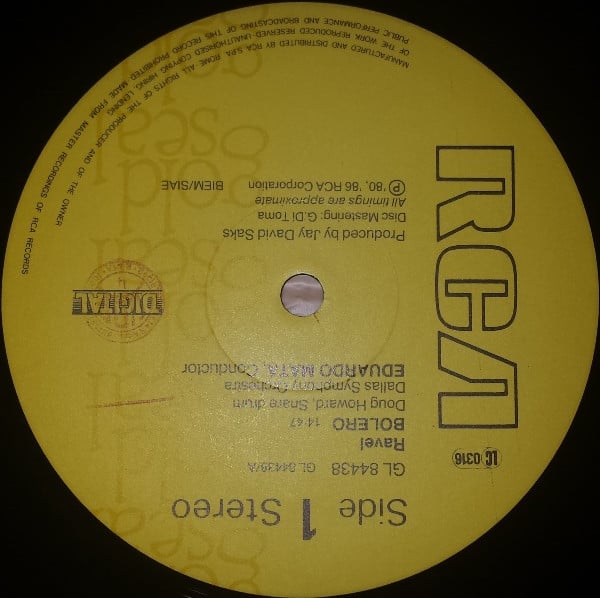
A1. Bolero 14:47
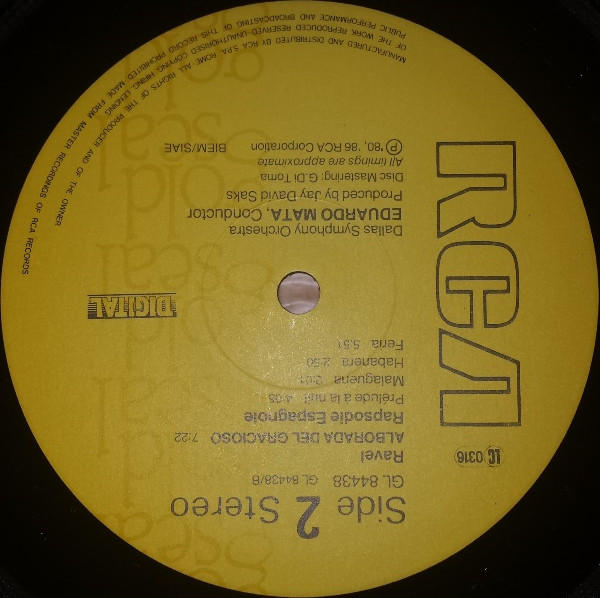
B1. Alborada Del Gracioso 7:22
. Rapsodie Espagnole
Barcode 0 035628 443816
Matrix / Runout GL 84438/A
Matrix / Runout GL 84438/B
Matrix / Runout (EDP)M1,SFI SM8 JA
Matrix / Runout ARCI-4438ⒶI-A
Matrix / Runout ARGL 84438- I7
Matrix / Runout (ATCI-4096A I)
Matrix / Runout (EDP)M2SFI SM5 JA
Matrix / Runout ARC-I-4438-B-10 A
Matrix / Runout ARC-I-4438-Ⓑ-10-A
Matrix / Runout ATCI-4096B-10
Rights Society BIEM / SIAE
Label Code LC 0316
Other RAVEL: Bolero / Mata
Other GK 84438
Price Code AG
Price Code RC 330
Price Code EF
Distributed By RCA/Ariola-Ariola/RCA
Distributed By Ariola/RCA-RCA/Ariola
Manufactured By RCA Records Factory, Italy
Distributed By RCA S.P.A.
Phonographic Copyright (p) RCA/Ariola International
Phonographic Copyright (p) RCA Corporation
Manufactured By RCA S.P.A.
Copyright (c) RCA/Ariola International
Copyright (c) RCA Corporation
Recorded At Cliff Temple Baptist Church, Dallas
Pressed By Europadisk